
Suburb Overview
Box Hill North is a tightly held, family-oriented market. It acts as the quieter, more suburban neighbor to the booming Box Hill Metropolitan Activity Centre, making it highly attractive to owner-occupiers who want the amenity without the congestion.
Demographics: The area is dominated by established families and professionals, with an average household size of 2.6 people. The high owner-occupier rate of over 63% indicates a stable residential community rather than a transient, investor-heavy market.
Property Values: The median house price remains solid at approximately $1.39 million to $1.4 million. Meanwhile, the median unit and townhouse market sits around $890,000 to $951,000, offering an accessible entry point for younger families or downsizers wanting to stay in the school zones.
Market Position: The suburb benefits heavily from its proximity to Box Hill’s infrastructure, transport network, and hospitals, making medium-density developments highly desirable if priced correctly.
Development Option (Feasibility Analysis)
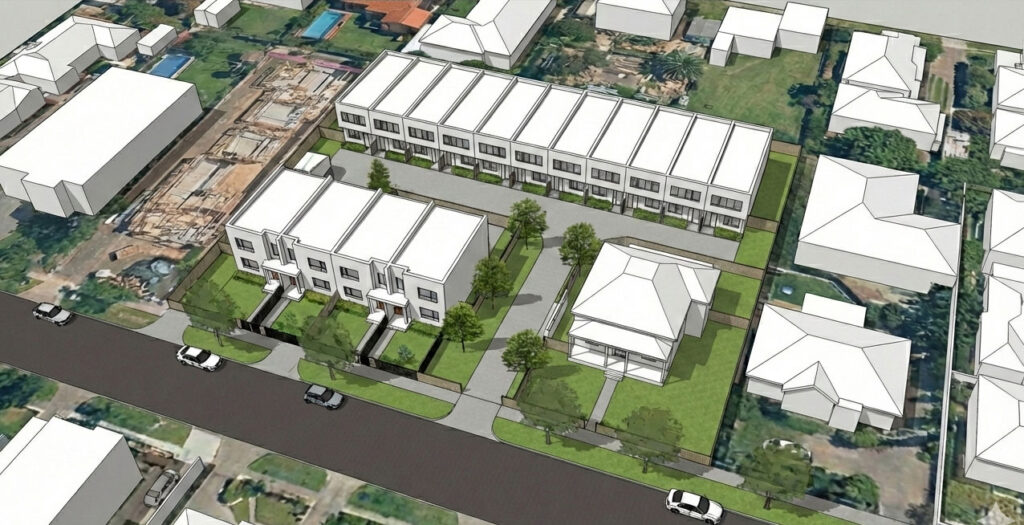
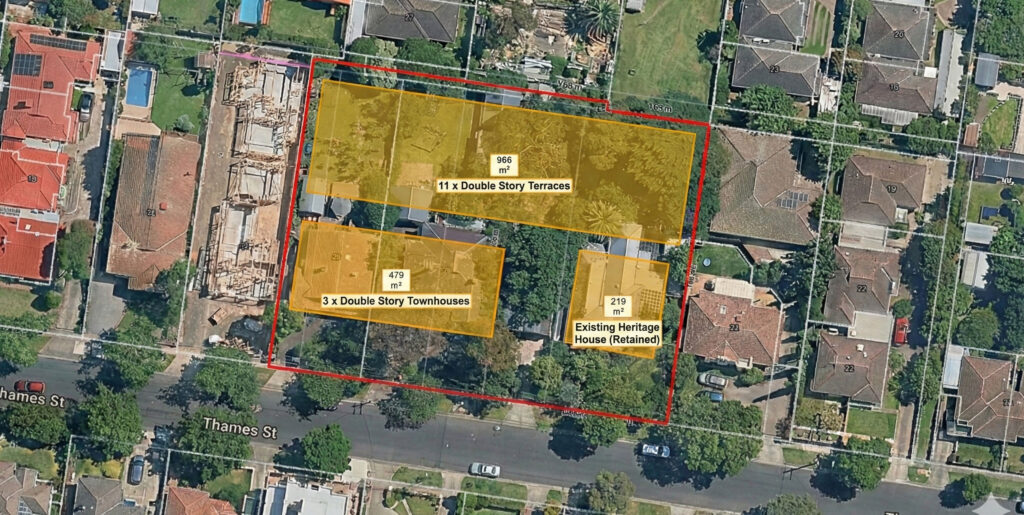
Project Profile: The proposed residential complex at Thames St. Box Hill North consists of 15 dwellings on a 3240 sqm site. The total project span is modeled at 2 years, which includes a 1.5-year construction phase.
Revenue Realization: The product mix is split into 3 street-front dwellings priced at $1,680,000 each, 11 standard units at $980,000 each, and 1 retained heritage unit priced at $1,000,000. After applying the margin scheme for GST and deducting selling costs (including a 5.5% sales commission), the Total Revenue (After GST Claimed) lands at AU$14,881,709.
Project Costs: Total Costs (After GST Claimed) are projected at AU$13,896,592. The major capital expenditures are the underlying land value at AU$6,600,000 and the turnkey construction sum (excluding slab stage) at AU$5,825,619.
Financial Metrics: The scenario yields a Net Profit Before Tax of AU$985,117. This translates to a Return on Equity (ROE) of 6.79% and an Internal Rate of Return (IRR) of 8.91%.
Capital Structure: The current feasibility assumes a 100% equity-funded capital stack, requiring an upfront injection of AU$14,513,075. Because there is no debt utilized, the Loan, Loan-to-Cost (LTC), and Loan-to-Value (LTV) ratios sit at 0.00%.
Conclusion
Frankly, the risk profile on this specific scenario is far too high for the projected payoff. While the 15-dwelling mix suits the Box Hill North demographic well, retaining and integrating a heritage unit introduces significant, hard-to-quantify construction and compliance risks.
When you pair the unknowns of heritage integration with the massive cash requirement (AU$14.5M) and high baseline costs, a 6.79% ROE simply doesn’t justify the effort. The profit margin is too thin to absorb any unforeseen heritage-related cost blowouts or holding delays. Unless you can drastically reduce the equity burden through smart debt structuring or reconfigure the site plan to remove the heritage constraints, the capital is better deployed elsewhere.