
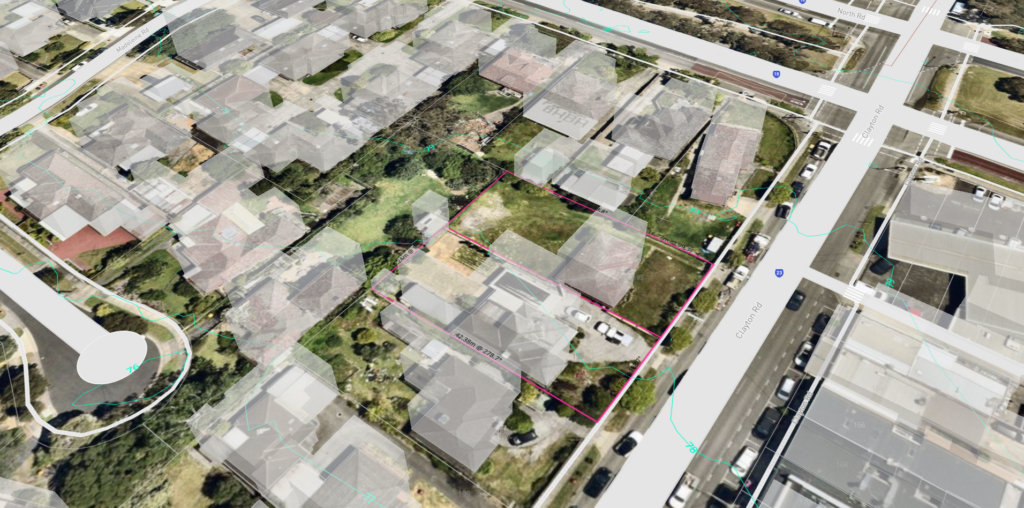
Suburb Overview
Over the past year, Clayton has consolidated its status as a major education and health precinct, underpinned by the expansion of Monash University, Monash Medical Centre, and the long-term infrastructure uplift associated with the Suburban Rail Loop (SRL East), reinforcing both owner-occupier and investor confidence. While detached house medians sit in the mid–$1.3M to low–$1.4M range depending on land size, the medium-density market has shown bifurcation: townhouses have outperformed due to limited “missing middle” supply and stronger appeal to families and downsizers, recording approximately 6–10% annual growth, whereas apartments—particularly older high-density stock—have experienced more moderate growth, primarily supported by resilient rental demand from university and hospital staff. For a project at 193–195 Clayton Road, well-designed 3–4 bedroom townhouses within walking distance of Clayton Station and the activity centre are currently achieving circa $1.15M–$1.30M depending on specification and street presence, while newer boutique apartments in the immediate precinct typically transact in the $520,000–$750,000 range (configuration dependent), with premium finishes, architectural façades, and proximity to transport continuing to command a measurable pricing premium.
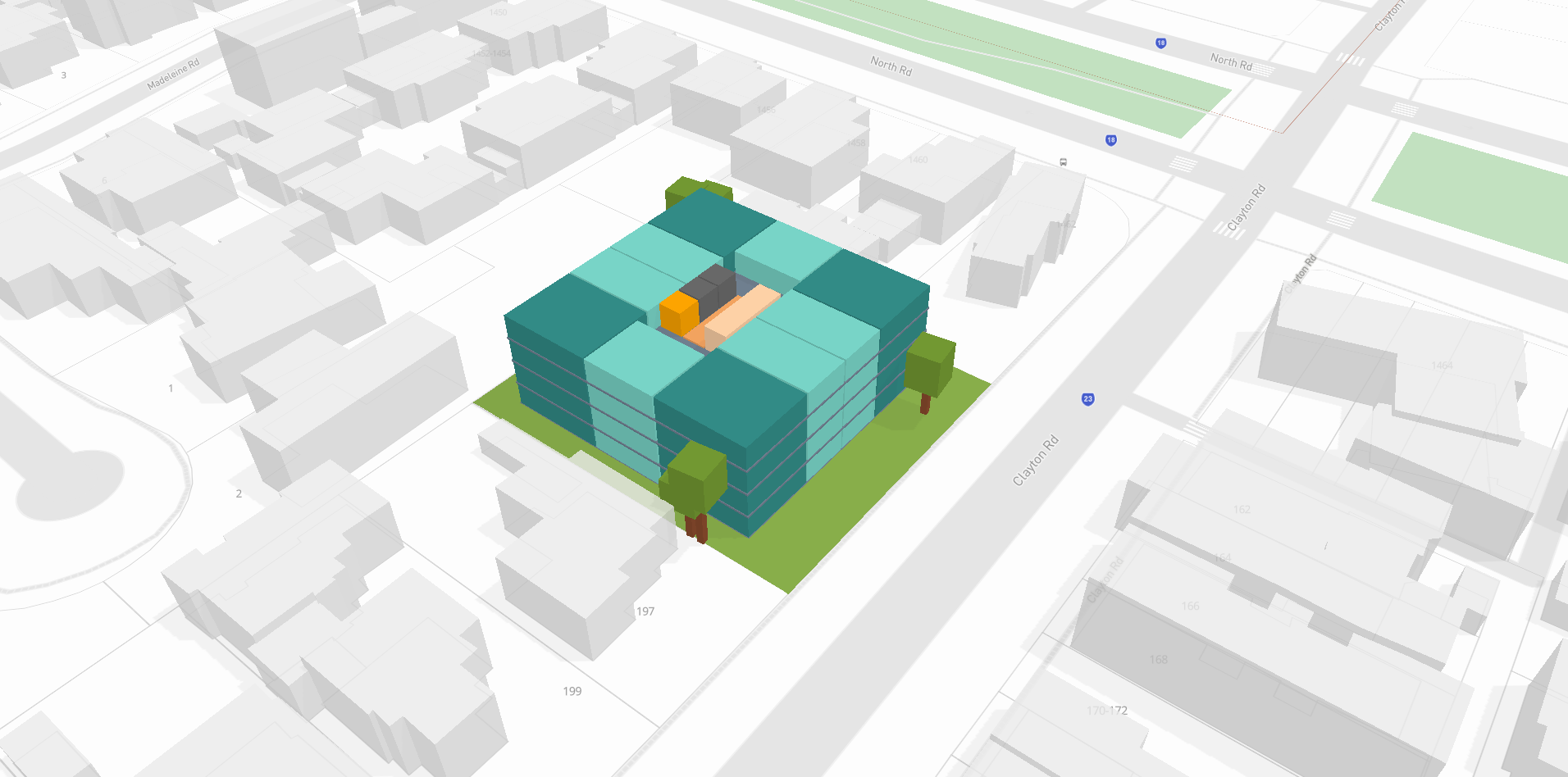
Apartment option
High-density, maximum use of the site: This scheme utilizes 30 units, heavily weighted toward 1 and 2-bedroom configurations.
Highest revenue potential at $17,363,060: Generates significantly more gross income due to the higher unit count.
Significant construction and development costs: Total project costs reach $15,994,886, with construction alone exceeding $10.8m.
Viable but capital intensive: Delivers a net profit of $1,173,763, resulting in a positive Return on Equity (ROE) of 7.34% and an IRR of 11.73%.
The “scale” scheme: Requires the most equity ($15.99m) but is currently the only profitable path of the two analyzed.
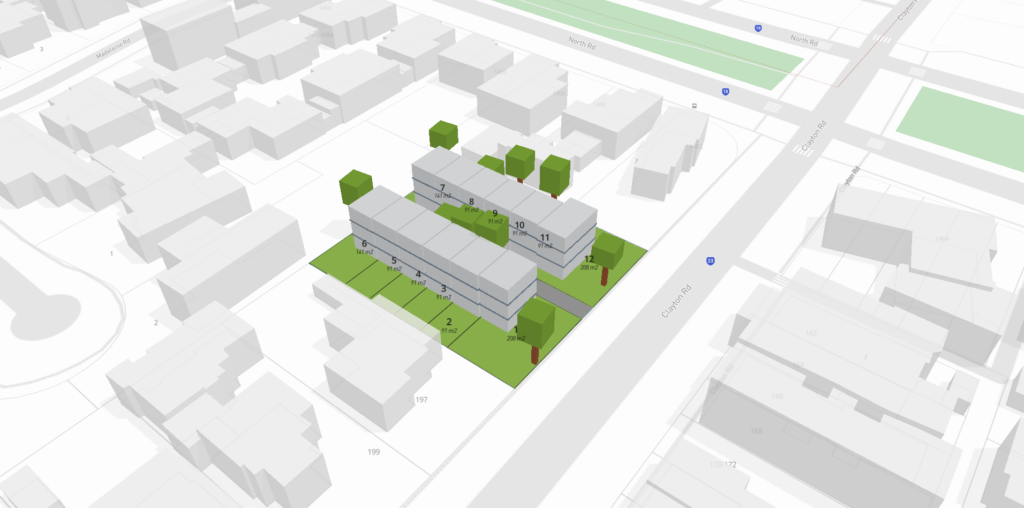
Townhouses option
Lower density, premium product focus: This scheme reduces the unit count to 12 larger dwellings, primarily 3-bedroom and 2-bedroom terrace-style homes.
Lower revenue at $11,010,252: Despite higher individual unit prices (up to $1.22m), the lower volume results in ~$6.35m less total revenue than the apartments.
Reduced construction and overhead costs: Construction costs are significantly lower at $6,582,258, bringing total development costs down to $11,518,768.
Non-viable at current land pricing: This scheme results in a net loss of $528,943.
Negative performance metrics: The project shows a negative ROE of -4.59% and a negative IRR of -7.37%, indicating that the current $4.24m land cost is too high for this specific density.
Conclusion
The Apartment Option is the only viable path for the site, as its high-density 30-unit design generates enough revenue ($17.36m) to cover costs and return a $1.17m profit with a 7.34% ROE. Conversely, the 12-unit Terrace Option lacks the scale needed to offset the $4.24m land cost, resulting in a $528,943 loss and a negative -4.59% ROE.